


Viktor G. Baryakhtar and his scientific school
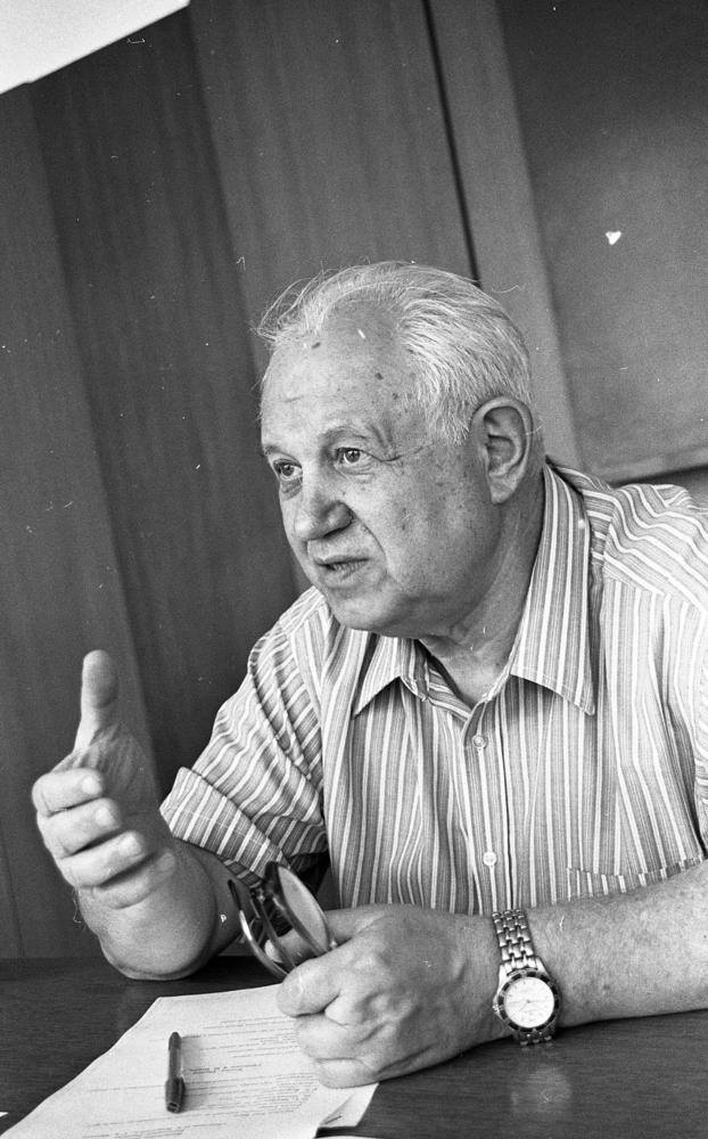 Viktor Gryhorovych Baryakhtar (August 2, 1930, Mariupol, Ukraine - August 25, 2020, Kyiv, Ukraine) Academician of the National Academy of Sciences of Ukraine, founder and first director of the Institute of Magnetism of the NAS of Ukraine and MES of Ukraine, Hero of Ukraine (2010).
Biography
Viktor G. Baryakhtar was born in Mariupol. His father, Grigory F. Baryakhtar, was a chemistry teacher, and his mother, Anna D. Paranich, was a physics teacher.
In 1948, Viktor Baryakhtar graduated with honors from high school in Luhansk and entered the Faculty of Physics at Leningrad State University (USSR). There he was taught by famous teachers in physics and mathematics of that time (B.N. Tsvetkov, S.E. Frish, V.A. Fok, A.V. Timoreva, L.E. Gurevich, V.I. Smirnov, V.I. Krylov and O. Ladyzhenskaya).
In 1951, by the initiative of I.V. Kurchatov, the best physics students from Leningrad, Kyiv, and Odesa were selected and transferred to Kharkiv to provide training for the nuclear industry, because Kharkiv was home to one of the largest nuclear physics research centers in the USSR and the world, the Ukrainian Institute of Physics and Technology (UPTI). Viktor Baryakhtar, being one of the best students, was transferred to Kharkiv after three years of study, where he continued his education at the Department of Nuclear Physics of the Faculty of Physics and Mathematics of Kharkiv University. At that time, there was a worldwide recognized scientific school of theoretical physics in Kharkiv, founded by the outstanding theoretical physicist, Nobel Prize winner L. D. Landau. Lectures on physics were given by highly qualified physicists known at that time - O.I. Akhiezer, I.M. Lifshitz, L.N. Rosenzweig, Y.B. Feinberg, L.M. Pyatigorsky, and on mathematics - O.Y. Povzner, Y.P. Blank, B.Y. Levin, V.O. Marchenko.
The group of theorists who worked at the UPTIis often called the Landau School. Viktor Baryakhtar wrote his thesis under the supervision of one of Landau's most famous students, Alexander Ilyich Akiézer. His thesis was devoted to the study of important aspects of the creation of electron-positron pairs in the process of electron scattering on nuclei.
In the fall of 1954, V.G. Baryakhtar entered graduate school under the scientific supervision of A.I. Akhiezer. Three graduate students, Peletminskiy, Fomin, and Baryakhtar, were assigned by A. I. Akhiezer to study the asymptotic behavior of Green's functions in quantum electrodynamics. Thus, A. I. Akhiezer created a “team”: Akhiezer, Baryakhtar, and Peletminskiy. After successfully completing his postgraduate studies and defending his PhD thesis, Viktor Baryakhtar was hired by the UFTI, where he worked until 1973.
Main results obtained by the team of Akhiezer, Baryakhtar, and Peletminskiy:
• theory of magnetoacoustic resonance in magnetics (invention certificate with priority from 1956, State Prize of Ukraine in 1987);
• theory of exchange relaxation and magnetic moment relaxation in ferromagnets;
• quantum theory of low-temperature thermogalvanomagnetic phenomena in metals and semiconductors;
• derivation of surface electric current and heat flux operators;
• theory of relaxation of a dilute plasma in ultra-strong magnetic fields;
• theory of beam instability in magnetics;
• theory of high-frequency susceptibility of ferrodielectrics.
It should be especially noted that in 1967, a worldwide-famous book on the physics of magnetic phenomena was published by A.I. Akhiezer, V.G. Baryakhtar and S.V. Peletminskiy, "Spin Waves". This monograph was reprinted in English in 1968.
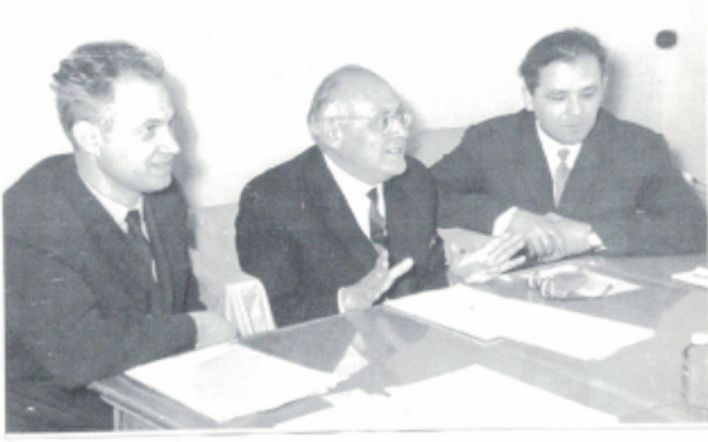 From left to right: V.G. Baryakhtar, O.I. Akhiezer, S.V. Peletminskiy, 1965.
In 1972, V.G. Baryakhtar was elected a corresponding member of the Academy of Sciences of the Ukrainian SSR. In 1978, he became an academician and a member of the Presidium of the Academy of Sciences of the Ukrainian SSR. His outstanding scientific and organizational achievements became the basis for the special attitude of the President of the Academy of Sciences of Ukraine Borys Paton.
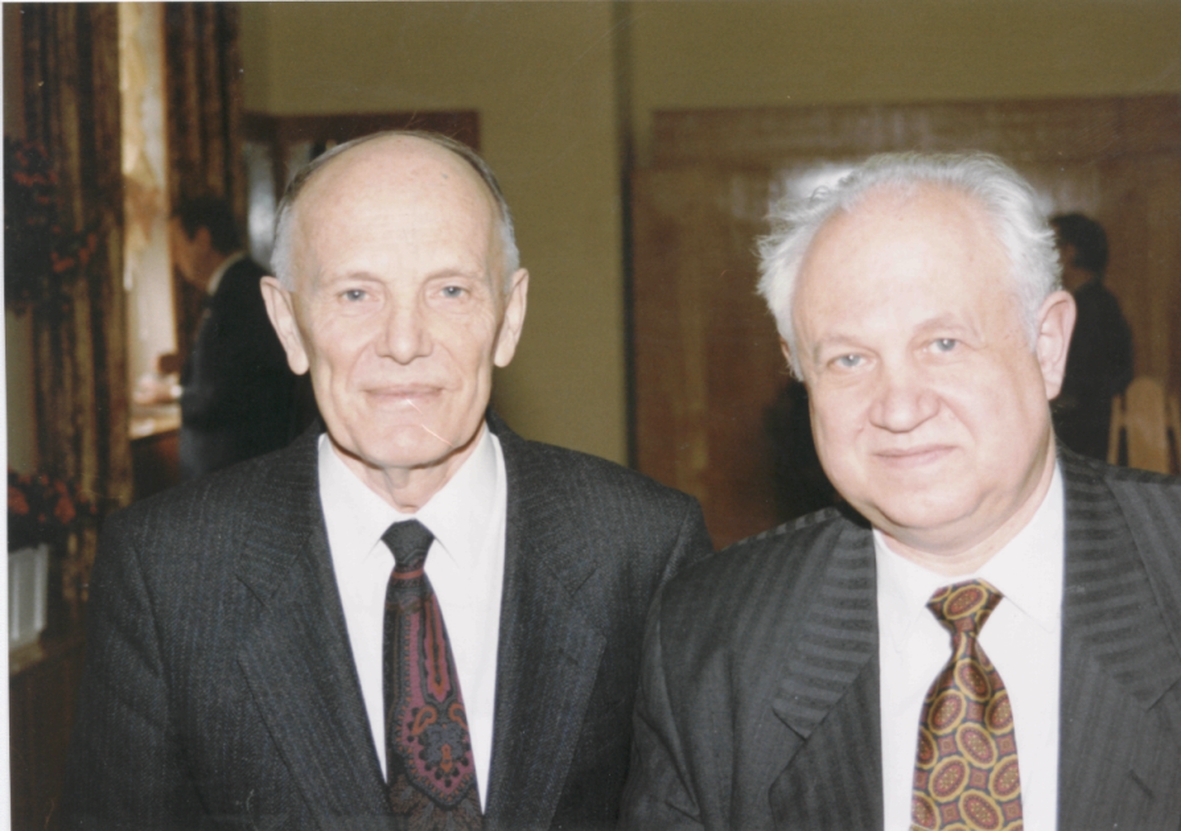 Viktor G. Baryakhtar (right) with Boris Ye. Paton (left).
In 1972, V. Baryakhtar was invited to Donetsk to head the theoretical department of the Donetsk Institute of Physics and Technology, where he worked from 1973 to 1982. During this period, he headed the Donetsk Scientific Center of the USSR Academy of Sciences and taught physics at Donetsk State University.
In the early 1980s, Viktor Baryakhtar was elected Academician-Secretary of the Department of Physics and Astronomy of the USSR Academy of Sciences, and moved to Kyiv. From 1982 to 1985, he worked as head of the department at the Bogolyubov Institute of Theoretical Physics of the Academy of Sciences of the Ukrainian SSR.
In 1983, he began lecturing at the Faculty of Physics at Kyiv State University. In 1985, he became the head of the Department of Theoretical Radiophysics at the Faculty of Radiophysics. In the same year, he became the head of the Institute of Metallophysics of the Academy of Sciences of the Ukrainian SSR.
From 1989 to 1998, he was Vice President of the National Academy of Sciences of Ukraine, and from 1994 to 1998, he was First Vice President of the National Academy of Sciences of Ukraine.
In 1995, in response to the suggestion of the rector of the Kyiv Polytechnic Institute M.Z. Zgurovsky, he founded and headed the Faculty of Physics and Mathematics of this institute.
Realizing the need for productive interaction between the National Academy of Sciences of Ukraine and the higher education system, Viktor Baryakhtar put forward the idea of creating a research institute with dual subordination to the National Academy of Sciences of Ukraine and the Ministry of Education of Ukraine. Such an institute - the Institute of Magnetism of the National Academy of Sciences of Ukraine and the Ministry of Education of Ukraine - was established in 1995 on the basis of the Department of Magnetism and several other departments of the Institute of Metallophysics of the National Academy of Sciences of Ukraine.
Despite his extraordinary workload in management and teaching, Viktor Baryakhtar was a talented theoretical physicist by heart. He is the author and co-author of about 650 scientific articles and more than 30 books. He was a scientific advisor and consultant to more than 50 scientists who have received PhDs and doctorates and are successfully working in Ukraine, the USA, Poland, Israel, Australia and other countries. Among V.G. Baryakhtar's academic followers are six laureates of the State Prize of Ukraine (Stefanovskyi E.P., Borovyk A.E., Popov V.O., Tarasenko V.V., Krivoruchko V.M., Yablonskiy D.A.), two heads of research institutes (V. Varyukhin and V. F. Klepikov), Academician V. Semynozhenko, Corresponding Member of the Academy of Pedagogical Sciences Yu. I. Gorobets, Corresponding Member of the National Academy of Sciences of Ukraine B. A. Ivanov.
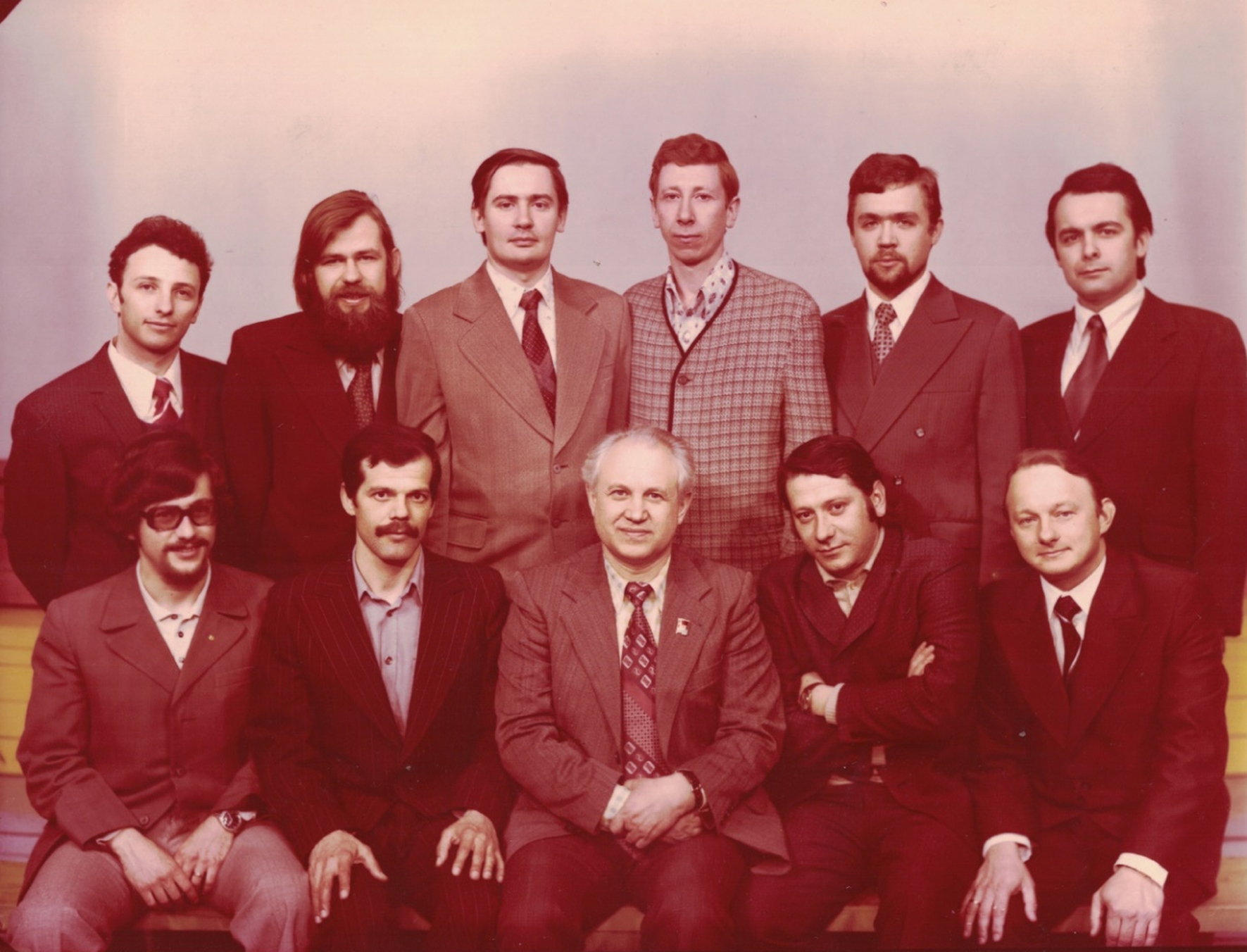 V. G. Baryakhtar Scientific School, 1980. From left to right. Top row: O.L. Sukstanskiy, B.A. Ivanov, Yu.I. Gorobets, D.A. Yablonskiy, V.P. Seminozhenko, V.F. Klepikov. Bottom row: V. L. Sobolev, A. E. Borovyk, V. G. Baryakhtar, E. P. Stefanovsky, V. V. Gann
Due to his extremely broad scientific outlook, V.G. Baryakhtar became the chief scientific editor of the Encyclopedic Dictionary of Solid State Physics (executive secretary of the editorial board E. Galkina), which was published in 1996. More than 500 well-known experts in solid state physics worked on the development of this encyclopedic guide. The dictionary received the highest marks from world-class experts and scientists, including Nobel Prize winner V. L. Ginzburg. In 2004, the English edition of the dictionary was published under the editorship of Charles P. Poole Jr.
In 2000, on the initiative of S. Dovgyi and with the participation of Viktor Baryakhtar, the Junior Academy of Sciences (JAS) was organized to work with creative youth. S. Dovgyi became the president of this organization, and V. Baryakhtar became the vice president. Among other things, V.G. Baryakhtar created physics textbooks for high school students, which, according to many experts, were among the best textbooks.
In the extremely difficult circumstances that developed as a result of the Chernobyl accident, V.G. Baryakhtar led a team from the Academy of Sciences of the Ukrainian SSR to deal with the consequences of the accident. With his unique experience in such work, he has been actively involved in solving important problems related to Ukraine's nuclear energy and, more broadly, its environment for many years.
Until the last years of his life, Viktor Baryakhtar was directly involved in scientific research, obtaining important world-class results. The research topics included a wide range of scientific problems, in particular, the development of new theoretical approaches to describe the attenuation of magnetoelastic waves in ferromagnetic crystals of different symmetry and the consideration of a special type of spin wave nonreciprocity in long-periodic spiral magnetic structures. The results obtained were published in leading physical journals of Ukraine and the USA, received a wide international response and are actively cited in the scientific literature.
For his significant contribution to the theoretical physics of magnetic phenomena in solids, scientific and pedagogical activities, and work on nuclear energy safety, Viktor Baryakhtar was awarded many orders and honorary awards by Ukraine and prestigious international organizations:
• Laureate of the State Prize of the Ukrainian SSR in Science and Technology for the series of works “Discovery, Theoretical and Experimental Study of the Intermediate State of Antiferromagnets” (1971),
• Order of the Red Banner of Labor (1971),
• K.D. Sinelnikov Prize of the USSR Academy of Sciences for work in physics (1978),
• Honorary title “Honored Worker of Science and Technology of the Ukrainian SSR” (1980),
• Krylov Prize of the Academy of Sciences of the Ukrainian SSR for his work in mathematical physics (1985),
• Order of Lenin (1986),
• Laureate of the State Prize of the Ukrainian SSR in Science and Technology for the discovery and study of dynamic phenomena associated with phonon interactions in magnetic crystals (1986),
• Bogolyubov Prize of the National Academy of Sciences of Ukraine (1993),
• Commemorative Medal of Pope John Paul II for work on overcoming the consequences of the Chernobyl disaster (1994).
• Order of Prince Yaroslav the Wise, V degree (1998),
• Laureate of the State Prize of Ukraine in Science and Technology for his work related to the elimination of the Chernobyl accident (1999),
• Prize of the International Federation of Scientists of the Catholic Scientific Foundation of St. Valentine (Italy, 2000),
• S.I. Pekar Prize of the National Academy of Sciences of Ukraine for the two-volume encyclopedic dictionary “Solid State Physics” (2004, co-authored),
• Vernadsky Gold Medal for the development of solid state theory and statistical physics (2009),
• Akhieser Prize of the National Academy of Sciences of Ukraine for the series of works “Some Problems of Solid State Physics and Quantum Electrodynamics” (2018).
• Awarded the title of Hero of Ukraine with the Order of the State (August 21, 2010) for outstanding personal services to the state of Ukraine in the development of physical science, exceptional achievements in the organization of basic research, and many years of fruitful scientific and pedagogical activity.
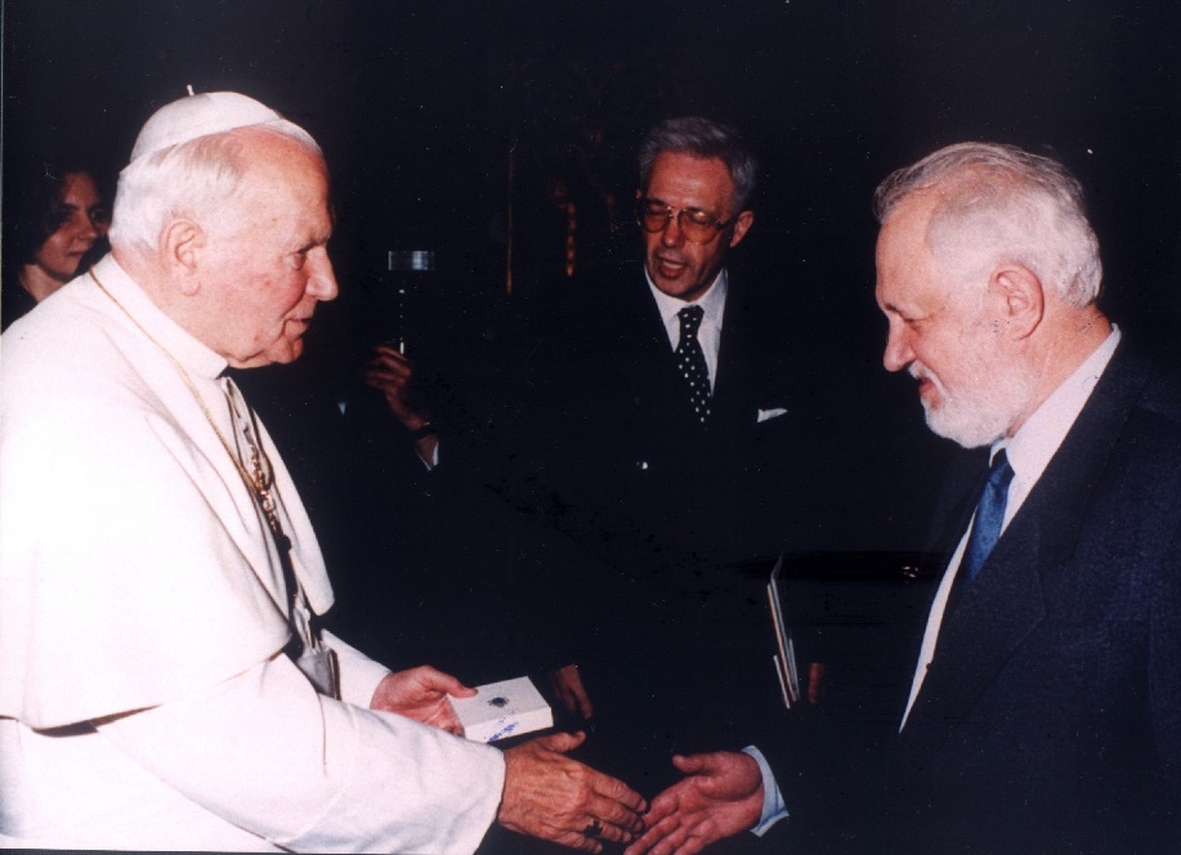 Pope John Paul II awards V.G. Baryakhtar with the Commemorative Medal for his heroic work in eliminating the consequences of the Chornobyl catastrophe, Rome, 1994.