


Scientific school of Boris Ivanov
Boris O. Ivanov (born December 22, 1948) is a famous Ukrainian theoretical physicist, corresponding member of the National Academy of Sciences of Ukraine, Doctor of Physical and Mathematical Sciences, Professor, laureate of the O. S. Davydov Prize of the National Academy of Sciences of Ukraine (2005) for the series of works “Vortex Dynamics in Magnets, and laureate of the State Prize of Ukraine in Science and Technology in 2013 for the series of scientific works “Nonlinear Waves and Solitons in Condensed Matter Physics.” In 2015, the American Physical Society awarded him the honorary title of “Outstanding Reviewer.”
Boris Ivanov is a prominent member of the famous Kharkiv School of Theoretical Physics, founded by Lev Landau. B.O. Ivanov's scientific school is based on traditions passed on to him by his teacher, the outstanding physicist Academician Viktor Baryakhtar, a student of O.I. Akhiezer, L.D. Landau, and M.M. Bogoliubov. Boris Ivanov's development was greatly influenced by his long-standing collaboration with A.M. Kosevich, as well as with L.D. Landau's former student I.E. Dzyaloshinskii.
Boris Ivanov established a school of physicists that gained recognition not only in Ukraine but also far beyond it. The formation of B. Ivanov's scientific school is the result of productive creative activity, when, during research into the most modern issues in physics, talented young people from among students and graduate students were involved in the work, creating a scientific team. The school is based on three generations of researchers: the founder of the school, his followers, and the students of his followers. Under his supervision, 17 scientists defended their PhD dissertations: A.L. Sukstanskiy (1979), A.V. Zuiev (1982), I.V. Baryakhtar (1983), N.V. Shakhov (1986), G.K. Oksyuk (1990), O.K. Kolezhuk (1991), K.A. Safaryan (1993), A.N. Kichizhiev (1994), D.D. Sheka (1995), V.E. Kireev (2002), I.A. Yastremskiy (2003), V. M. Muravyov (2003), R. S. Khymyn (2009), P. V. Bondarenko (2013), S. A. Dzyan (2014), D. V. Filin (2014), A. V. Bondarenko (2019). Seven of his graduates became doctors of science: A.L. Sukstanskiy, I.V. Baryakhtar, O.K. Kolezhuk, D.D. Sheka, O.V. Tartakivska, Yu.N. Mitsai, and Yu.A. Fridman. Most of them became independent scientists and are actively working in science. O.K. Kolezhuk was elected a corresponding member of the National Academy of Sciences of Ukraine and, in addition to his scientific work, is also involved in the organization of science in Ukraine. O.K. Kolezhuk received the prestigious European Heisenberg Prize and became a laureate of the State Prize of Ukraine in Science and Technology. Doctor of Physical and Mathematical Sciences D.D. Sheka received the O.S. Davydov Prize of the National Academy of Sciences of Ukraine.
Boris Ivanov is well known both in Ukraine and abroad as a highly qualified physicist with a broad worldview. He actively and fruitfully works in various fields of physics. No matter what field of physics he worked in—theory of magnetism, nonlinear physics, superconductivity, macroscopic quantum tunneling, nanophysics—he always achieved pioneering and interesting results.
Boris Ivanov conducted a series of pioneering studies in the field of soliton physics of condensed media. In collaboration with A.M. Kosevich and A.S. Kovalev, he discovered and studied stable localized two-dimensional and three-dimensional magnetic solitons—magnon droplets. B. Ivanov was the first to describe three-dimensional topological solitons and the effect of spontaneous transition of a radial soliton into an elliptical one. Recently, they were detected in experiments on the excitation of solitons in magnetic films by spin-polarized current.
B.O. Ivanov conducted a series of studies on the dynamics of two-dimensional solitons (vortices) in different magnetics. He analytically explained the specifics of the motion of topological solitons of the vortex type, based on the results obtained by modeling on supercomputers at Los Alamos National Laboratory (USA). This series of studies gained enormous resonance when research began on the propagation of magnetic excitations in ordered arrays of magnetic nanoparticles, so-called magnetic dots. Such systems are now considered the most promising materials for information recording and processing systems. The main state of such particles is magnetic vortices. B.O. Ivanov was the first to predict the excitation of low-frequency oscillations with high quality factor of the vortex core in a magnetic nanoparticle. This is currently the most promising method for creating nanogenerators of microwave oscillations. The above results were subsequently confirmed experimentally in many studies conducted at leading scientific centers around the world. B.O. Ivanov's priority in this field is evidenced by more than 1,000 citations of his works devoted to the dynamics of vortices in nanoparticles.
In 1979, Ivanov B.O. proposed the sigma model for describing antiferromagnets, which is now the basis of modern classical and quantum theory of antiferromagnetism. He showed that even in a macroscopic object—a soliton containing thousands of spins—there are quantum coherent underbarrier transitions. This prediction opens up new possibilities for the creation of purely magnetic elements of quantum computers.
In recent years, B.O. Ivanov has been actively involved in the development of a new field in physics, femtomagnetsim, which is related to the possibility of ultrafast manipulation of the magnetic moment of nanoparticles using femtosecond laser pulses. His work in this field, carried out in collaboration with experimental groups from Europe and Japan, has been cited more than 500 times. He participated in the implementation of the fastest known “inertial” mechanism for spin reorientation in weak ferromagnets at that time (2009). Then, in 2012, he proposed an exchange mechanism for nonlinear spin evolution, thereby explaining the observation of an even faster (on the order of 2-3 picoseconds) “switching” of the magnetic moment of ferrimagnetic GdFeCo alloy particles under the action of a laser pulse. These effects could form the basis for increasing the speed of information recording on magnetic media.
Boris Ivanov has published more than 300 scientific articles, five book monographs (three with the Naukovaya Dumka publishing house, one of which has been translated into English, and one published by Springer-Verlag) and ten reviews (in Phys. Reports, Sov. Phys. Uspekhi, Low Temp. Phys., and in a series of reviews on physics published by Gordon & Breach). His scientific articles have received more than 8,500 citations in the world scientific literature with a total Hirsch index of 46 (as of 2026).
Being a well-known theoretical physicist, he was invited to conduct joint research at leading foreign scientific centers, such as the universities of Kansas and Montana, Los Alamos and Argonne National Laboratories (USA), universities in the Netherlands, Germany, Poland, the Czech Republic, and Sweden, as well as the RIKEN Center for Advanced Scientific Research and the University of Tokyo in Japan. For his scientific achievements, Ivanov B.O. was awarded the O.S. Davydov Prize of the National Academy of Sciences of Ukraine in 2006 and the State Prize of Ukraine in Science and Technology in 2013.
B.O. Ivanov worked for many years on the Expert Council on Physics of the Higher Attestation Commission of Ukraine and was a member of the Specialized Councils for the defense of dissertations at several institutes of the National Academy of Sciences of Ukraine. He was a member of the editorial board of the encyclopedic dictionary “Solid State Physics,” published by the Academy of Sciences of Ukraine and reprinted in English in 2003 by Academic Press. B. O. Ivanov is a member of the Advisory Board of the journal “Low Temperature Physics” (Kharkiv). The American Physical Society recognized him as an Outstanding Referee for journals published by the society (Physical Review Letters, Physical Review, and others).
For 40 years, B.O. Ivanov has been giving lectures on theoretical mechanics, solid state physics, and condensed matter physics, as well as special courses on magnetism and soliton theory at the faculties of radiophysics and physics at Taras Shevchenko National University of Kyiv, supervising the work of graduate students and postgraduates. B.O. Ivanov's followers, who continue and advance the research he initiated, are independent scientists and are themselves leading work in various areas of solid state physics, magnetism, nanophysics, and nanotechnology. Boris Ivanov and his graduates regularly publish the results of their research in high-impact journals such as Nature Materials, Nature Communications, Physical Review Letters, Applied Physics Letters, Physical Review, and others. It is also important that his graduates already have their own students who are working fruitfully in the scientific field.
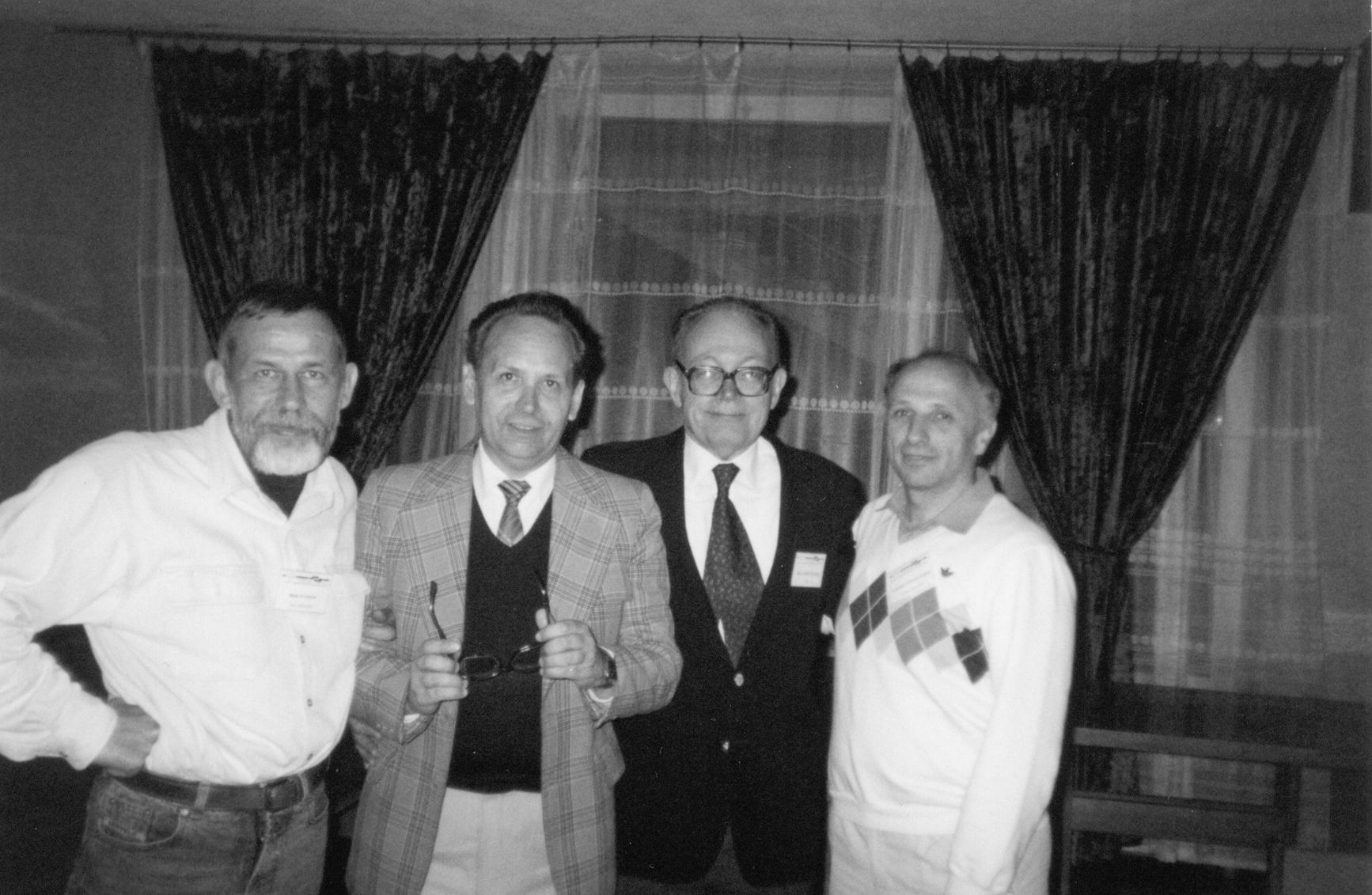 With his first student, A.L. Sukstanskiy, and the author of the spin-transfer-torque effect discovery, J.C. Slonczewski, 1997. From left to right: B.O. Ivanov, M.V. Chetkin, J.C. Slonczewski, A.L. Sukstanskiy
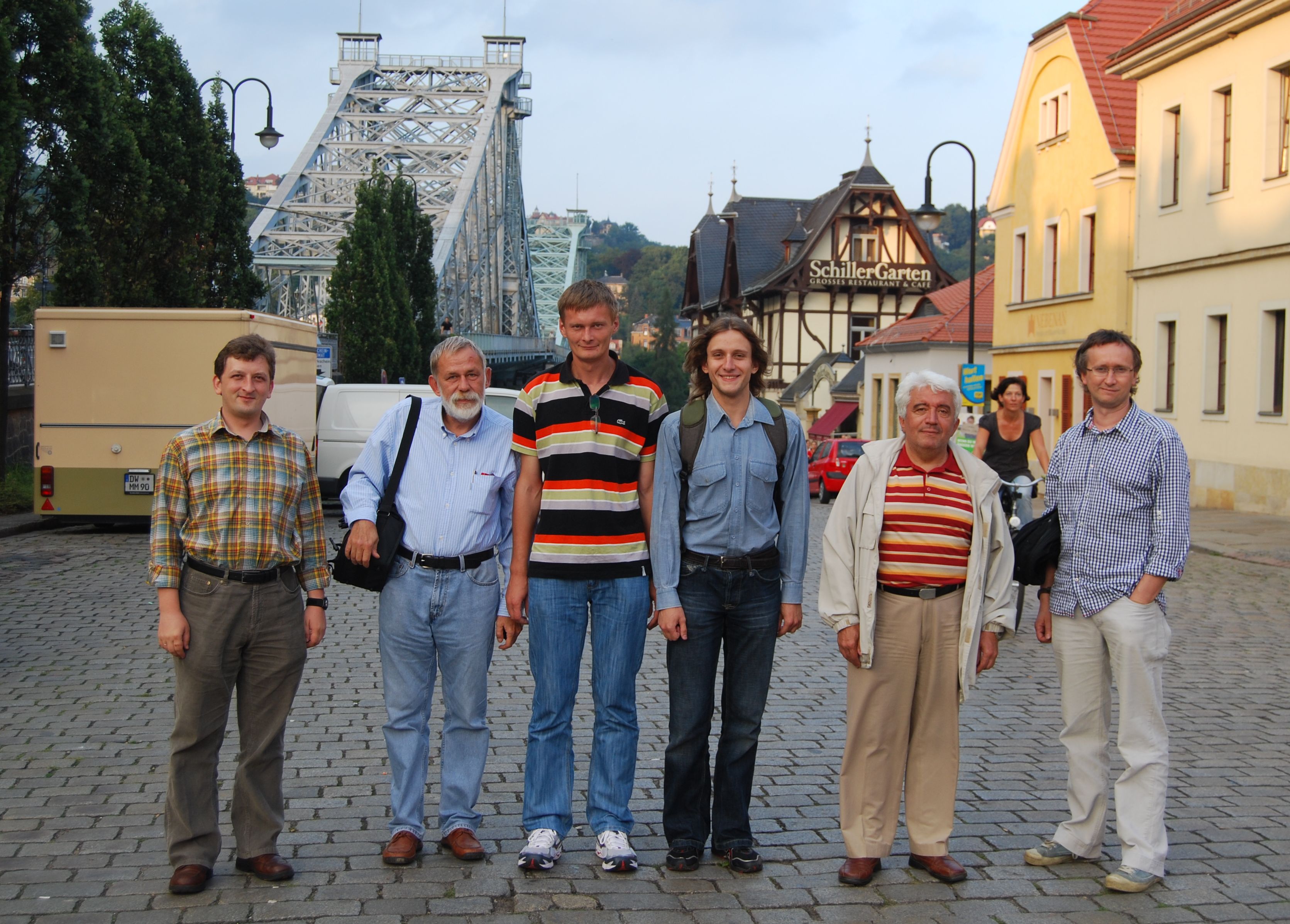 With his students Roman Khymyn and Pavlo Bondarenko (2nd and 3rd from left), and foreign colleagues Vasyl Tyberkevych and Maciej Krawczyk (last on the left and right). Dresden, 2009.
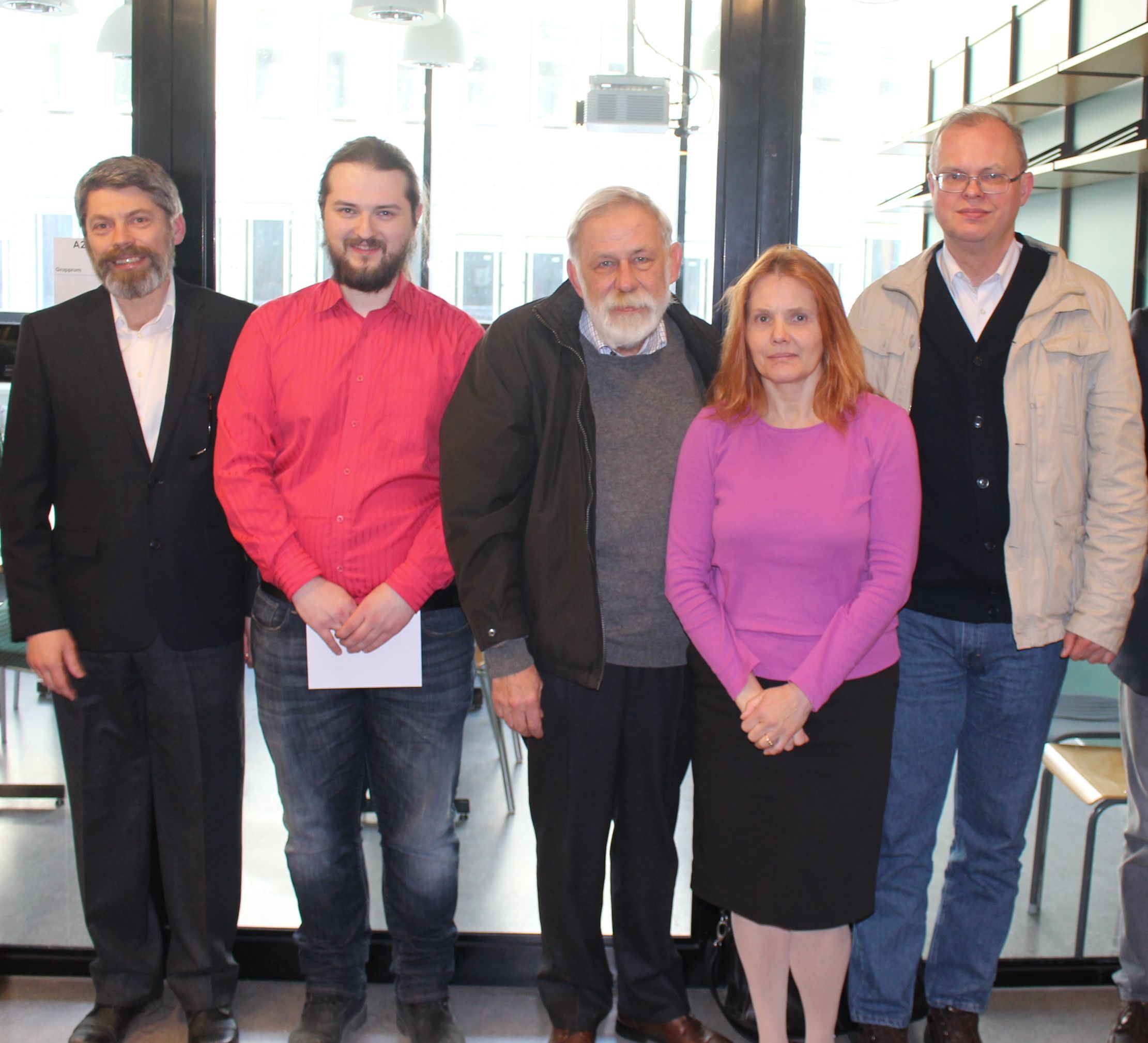 With the youngest student, A.V. Bondarenko, Stockholm, 2019. From left to right: Vladislav Korenivski, Artem Bondarenko, Boris Ivanov, Olena Gomonay, Gleb Kakazei
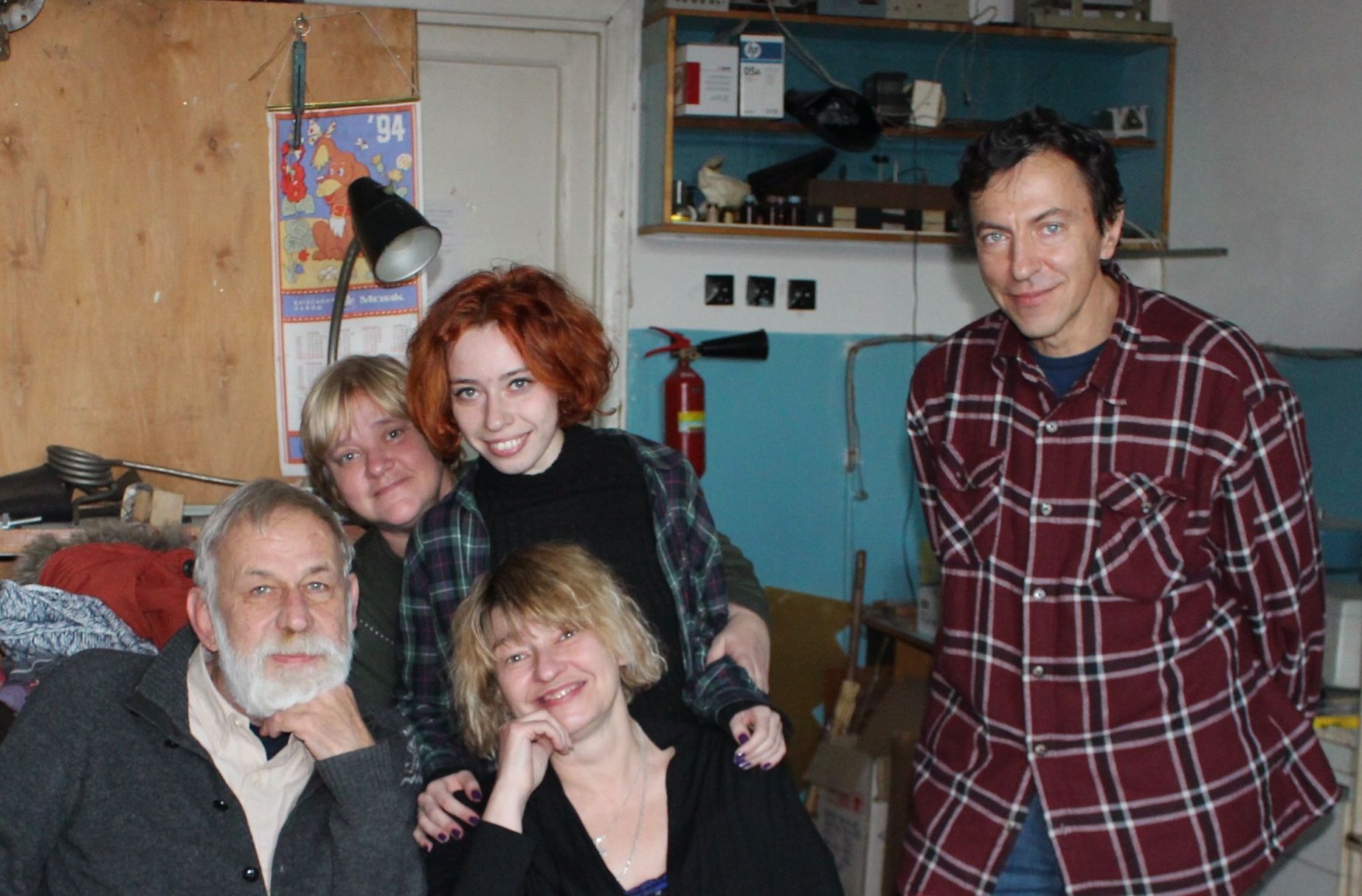 With colleagues from Department 01, Institute of Magnetism, 2021. On the photo: B.O. Ivanov, O.Yu. Saliuk, Yu.I. Kharlan, O.V. Tartakivska, and V.O. Golub.